
Preparing the flight
AI-first software studio
We turn prototypes, platforms and workflows into production software that runs without supervision. SaaS platforms, business applications and AI automation, at a fixed scope and a fixed price.
A model doing something impressive once, with someone watching, is a solved problem. It's also where most AI projects stop. The prototype can't handle real users. The platform can't take a second client. The automation gets pointed at the wrong workflow and quietly retired.
Dynode is an AI-first software studio that builds for the other side of that gap: prototypes taken to production, SaaS platforms and business applications, and AI wired into the operations you already run. Every system we ship has to keep working when no one is in the room, and move a number someone in your business already tracks. If it can't clear that bar, the audit says so and we don't build it.
You have a demo that works. We turn it into a product that holds up to real users, real data and real clients. We review what exists, keep what's sound, rebuild what isn't, and launch in weeks.
Multi-tenant SaaS platforms, internal tools and process-specific applications, built around how your company actually works. Senior engineers working alongside AI agents take it from blueprint to production. Not a prototype you'll have to rebuild: the real thing, with tests, monitoring and a rollback path.
LLMs, retrieval and automation embedded where they move your metrics: inside your CRM, support desk and operations, not bolted on beside them. Instrumented from day one, so you can see whether it's working instead of guessing.
Our products
The clearest thing we can show you isn't a case study — it's software you can open right now. These are ours: designed, built, and operated by Dynode, on the same process we'd use on your build.
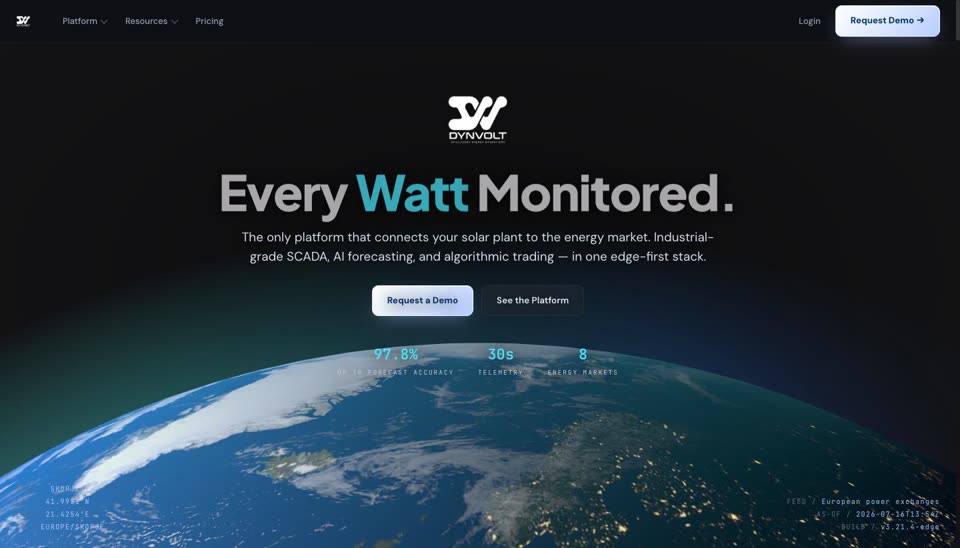
Industrial SCADA/EMS, AI production forecasting and energy market intelligence for utility-scale solar and battery operators. When a forecast is wrong, the cost is real money in a real market. There is no demo mode.
Visit dynvolt.com →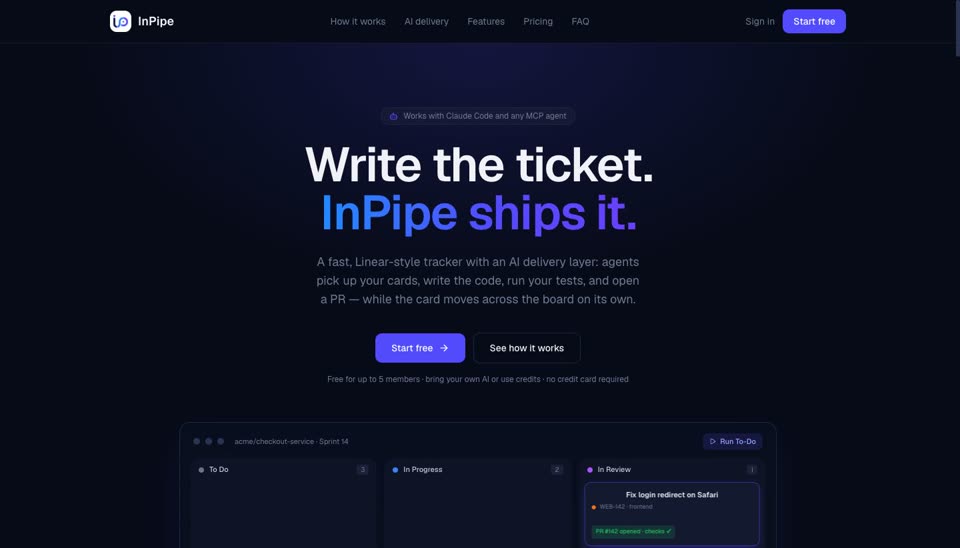
A project tracker with an AI delivery layer: agents pick up your cards, write the code, run the tests, and open the PR against your repository. Write the ticket — InPipe ships it.
Visit inpipe.app →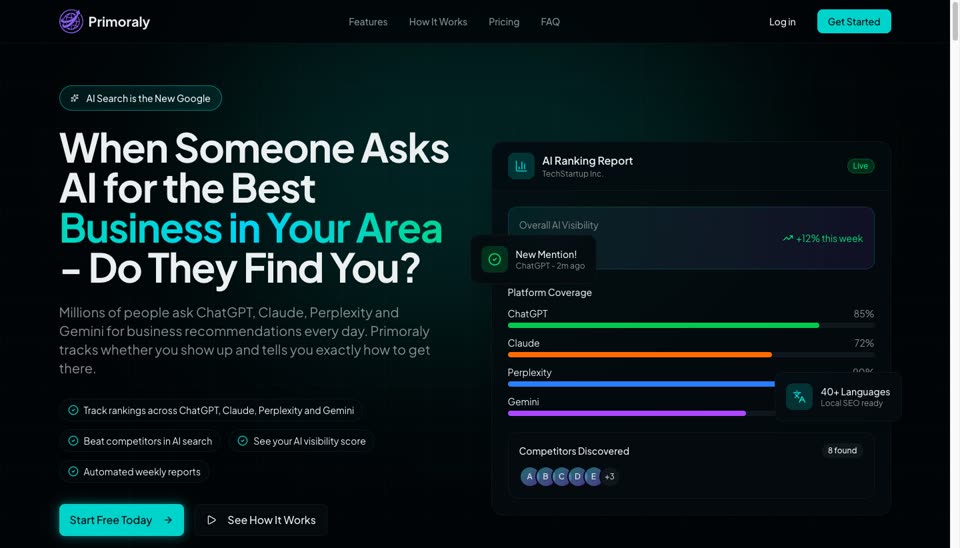
AI Search Optimization: tracks whether ChatGPT, Claude, Perplexity, and Gemini recommend your business, and tells you exactly how to change that. Customers make positioning decisions on the output.
Visit primoraly.com →None of these would survive as a demo. They run unattended or they don't run at all — which is the standard we hold client builds to.
How we work
Fixed price. We review your workflows, data and any existing code, and rank what's worth building. Sometimes the answer is don't build, which is the cheapest outcome for you.
Architecture, scope and milestones in writing, with a fixed price for the build. Yours to keep either way.
Working software demos every week. Prototype-to-production projects typically land in 4–8 weeks.
We host, monitor, support and keep building on a monthly retainer. Or we hand over everything: code, documentation and the evaluation setup.
One more step
Tell us what you're building: a prototype that needs to become a product, a platform for your clients, or the workflow that's costing you. We'll reply within one business day with how we'd approach it, or tell you plainly if we're not the right call.
Audits are a fixed price, quoted before you commit. Builds are scoped and fixed-price after the blueprint. You always know the number before we write code.
One week for the audit and one for the blueprint. Prototype-to-production projects then typically take 4–8 weeks, new builds 4–12 weeks. You see working software every week during the build.
Yes, it's one of our most common starting points, whether it was built by another team or with AI coding tools. The audit tells you what to keep, what to rebuild and what it will cost, before you commit to a build.
Both. We build complete multi-tenant platforms (auth, roles, billing, admin, hosting) and add AI where it earns its place. DYNVOLT, Primoraly and InPipe are built exactly this way.
Senior engineers, led by the person who designs your system. We scale the team with specialists per project, and you talk directly to the people building it, not an account manager.
We're model-agnostic: OpenAI, Anthropic, and open-weight models, retrieval (RAG) pipelines, and the modern web stack — plus integrations into CRMs, support desks, and internal tools your team already uses.
Your data stays in your accounts and infrastructure wherever possible. We design for least-privilege access, review data flows during the audit, and document exactly what is sent to which model provider and why. We deploy in the cloud region your customers or regulators require.
Both: founders, growing companies and larger organizations. Build engagements fit best when there's a real product or workflow with users and volume behind it.
Then that's the deliverable, and it's the cheapest possible outcome for you. You keep the process map, the opportunity ranking, and the reasoning — and you've spent the price of an audit instead of the price of a build that wouldn't have paid for itself. It happens, and we'd rather it happen at the audit stage.
You do, unless the contract says otherwise. We also offer other licensing models, such as a lifetime license with hosting and maintenance included. Whichever you choose is agreed in writing before work starts.
You can, we can, or both. Handover includes documentation, the evaluation setup, and access to everything we built — it's your system in your infrastructure. An ops retainer is available if you want us watching it, but it's a choice, not a dependency we engineer in.
Send a note through the form above or email hello@dynode.ai. We reply within one business day with a short set of questions, then a call — and you'll know after that call whether an audit makes sense.