On this page6 sections
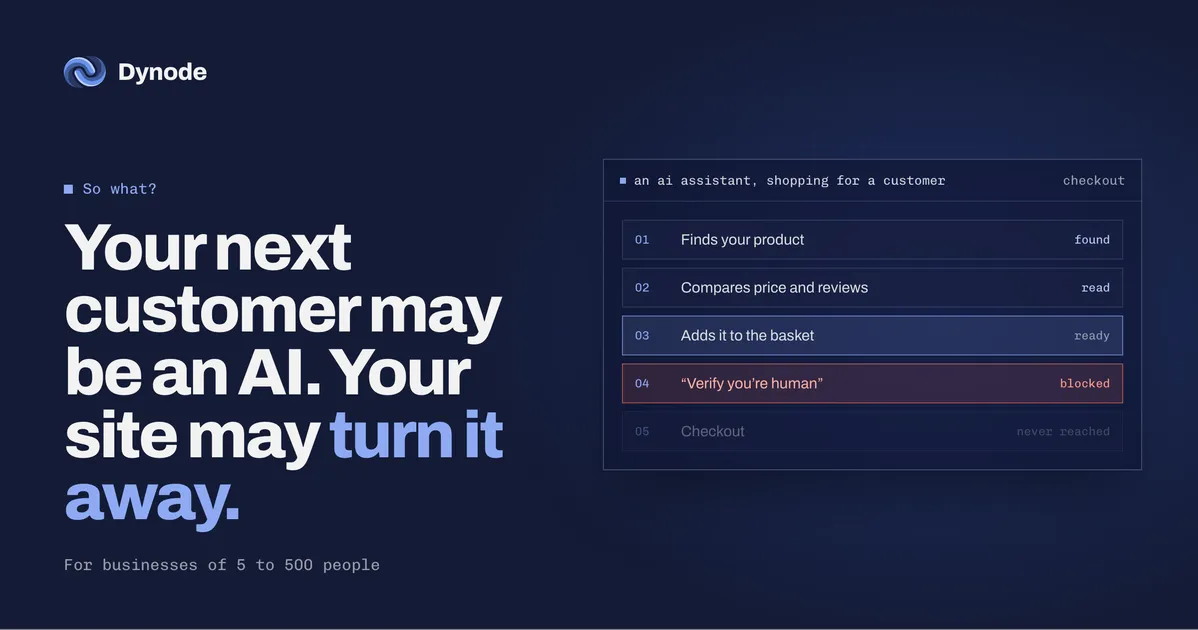
A customer opens an AI assistant and types: find me a good pair of running shoes under $150 and order them. The assistant searches, compares, picks a store, and goes to check out. Then the store says no.
This is already happening, at some of the biggest names online. Within two weeks of Meta launching its Muse shopping assistant in the US in September, Amazon shut it out. Yelp, Delta and United turn similar assistants away too. And since 15 September, many sites behind Cloudflare, which says it sits in front of roughly a fifth of the web, turn them away by default on pages that show ads.
Most business owners have never checked whether their own site does the same. Here is what happened, why it matters for a business of 5 or 500 people, and what to check this week.
What happened
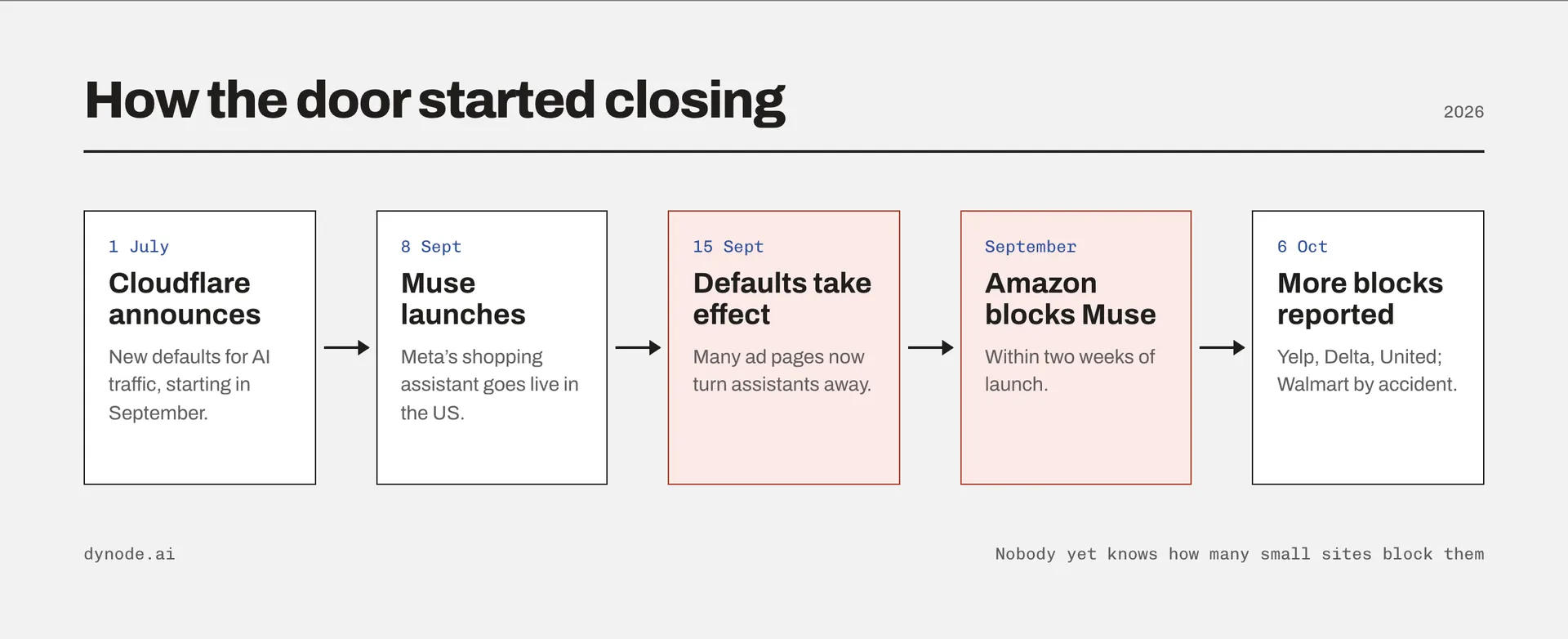
Amazon blocked Meta’s Muse. Muse launched in the US on 8 September. Within two weeks, people using it to buy on Amazon started seeing a popup: “Continued access by an unauthorized AI agent violates Amazon’s Conditions of Use.” According to reporting on the block (opens in a new tab), Amazon’s reasons were that Meta never told it Muse would shop there, that Muse does not identify itself, and that it appears to store customers’ login details. Meta says Muse cannot see passwords or payment details.
Others turn assistants away too. TechCrunch reported (opens in a new tab) in October that Yelp only lets this kind of traffic in through paid data licensing, so an assistant trying to request a quote or join a waitlist without a formal partnership will likely fail. Delta has no partnership that lets outside assistants book and says it acts against unauthorised automated activity. United points to its terms of use, which ban automated access without written permission.
Walmart turns them away by accident. Walmart is one of Muse’s launch partners, and it still fails. The usual culprit is a “verify you’re human” check: if the person’s session is interrupted, the check fails and the assistant is shut out. Walmart says these failures are unintentional.
Cloudflare changed the default. Since 15 September, Cloudflare’s default for ad-supported sites lets search engines in, refuses AI training, and turns away AI assistants acting for a person on pages that show ads. Cloudflare’s reasoning, as PYMNTS reported it (opens in a new tab): an ad means the page was built for a person, and an assistant reads the price and the reviews but never sees the ad. The default applies to many sites, especially new ones and those on the free plan. Paid customers with existing settings reportedly keep them, and owners can change the settings.
So what? Turning away the assistant turns away the customer
Meta put the argument in one line: “Turning away a personal agent means turning away the customer behind it.” For a big marketplace, blocking one assistant is a strategic choice. For a 20-person shop, a booking business or a service firm, it is usually not a choice at all. It is a default nobody looked at.
Three numbers show why it is worth looking:
About 132 million US adults have already bought a retail product with AI’s help, according to a PYMNTS Intelligence survey.
Three to five times better. That is how much better Cloudflare says visitors referred by AI convert compared with traditional search. It is Cloudflare’s own figure, but it points the same way as everything else: people who arrive through an assistant tend to arrive ready to buy.
Only about one in four shops can see it. The same survey found 23% of merchants can identify both AI visitors and the purchases they lead to. Another 21% see the visitors but cannot connect them to a sale.
Put together, a growing group of ready-to-buy customers is arriving in a way most businesses cannot see, and some of those businesses are turning them away without knowing.
Two sides of the door
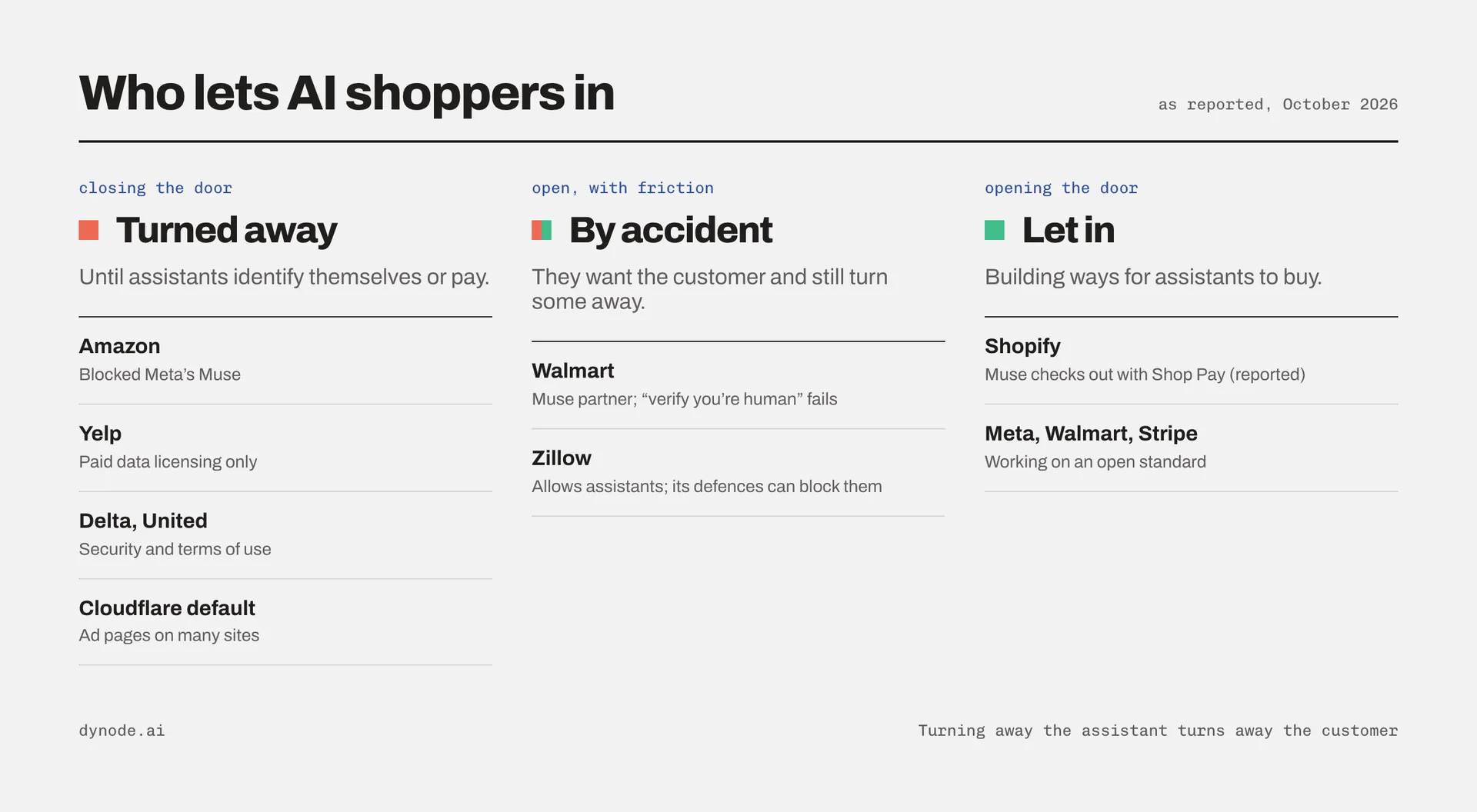
The big companies are splitting into two groups. Amazon, Yelp, Delta and United are closing the door, at least until assistants identify themselves or pay. Shopify, by contrast, has reportedly partnered with Meta so Muse can check out with Shop Pay. And Meta, Walmart, Stripe and others are working on an open standard for how assistants talk to businesses. Meta says the aim is to tell assistants acting for real customers apart from unwanted automated traffic, and to give businesses “more predictable control”.
The most useful lesson for a smaller business is Walmart’s. Walmart wants these customers and still turns some away, because a security check built for people does not know what to do with an assistant. You can block buyers without ever deciding to.
What nobody knows yet
Nobody can tell you how many small business sites block AI shopping assistants today. Cloudflare told TechCrunch it has no such figure, and its public traffic data does not separate wanted assistants from unwanted traffic. That is a reason to check your own site, not to assume it is fine.
What to check this week
Try it yourself. Ask an AI assistant to find one of your products, book one of your slots or request a quote from your site. Watch where it gets stuck.
Check your Cloudflare settings. If your site runs through Cloudflare, look at its AI settings and note what your plan does by default. Then decide on purpose, page by page.
Find your “verify you’re human” checks. List where they fire: checkout, booking, quote forms, login. Those are the points where an assistant, and the customer behind it, is most likely to be turned away.
Separate what you protect from where you sell. Paid content and member areas may have good reasons to stay closed. Product pages, prices, availability and booking usually want buyers, however they arrive.
Make the important facts readable. Prices, opening hours, availability and what you offer should be plain text on the page, not only inside images or behind a click. An assistant can only recommend what it can read.
Learn to see AI visitors. Check whether your analytics show visits referred by AI assistants, and whether you can tie them to enquiries or sales. Most businesses cannot yet. Being able to is a head start.
The decision is yours, as long as you make it
There are good reasons to keep some assistants out: an assistant that hides who it is, stores customers’ logins, or takes content you sell. There are also good reasons to let the right ones in, because there is a customer behind each one. What matters is that it is your decision, page by page, and not a default you never saw.
If AI is starting to change how your customers reach you and you want help working out what to open, what to protect and how to measure it, that is the kind of work our AI integration team does. Most engagements start with a one-week audit at a fixed price.
Sources: TechCrunch, 6 October 2026 (opens in a new tab); PYMNTS (opens in a new tab); TechCrunch, 1 July 2026 (opens in a new tab); PPC Land (opens in a new tab).
FAQ
3 short answers, if you skimmed to the end.
Are AI shopping assistants being blocked from websites?
Yes, at some large sites. Within two weeks of Meta launching its Muse shopping assistant in the US in September 2026, Amazon blocked it. Yelp, Delta and United also turn similar assistants away, and since 15 September 2026 Cloudflare’s default turns them away on pages with ads on many sites, especially new and free-plan ones.
Does Cloudflare block AI assistants on every site?
No. The default applies to pages that show ads, mostly on new sites and free-plan accounts. Paid customers with existing settings reportedly keep them, and owners can change the settings.
How do I know if my site turns AI assistants away?
Ask an AI assistant to find a product, book a slot or request a quote on your site and watch where it gets stuck. Then check your Cloudflare AI settings if you use Cloudflare, and list where your verify-you-are-human checks appear.