
From Chatbots to AI Agents: What 'Agentic AI' Really Means for Your Operations in 2026
Discover what agentic AI means for business operations in 2026. Learn how AI agents differ from chatbots, see real ROI data (20-35% efficiency gains), and understand why Meta's $2B Manus acquisition signals a massive shift.
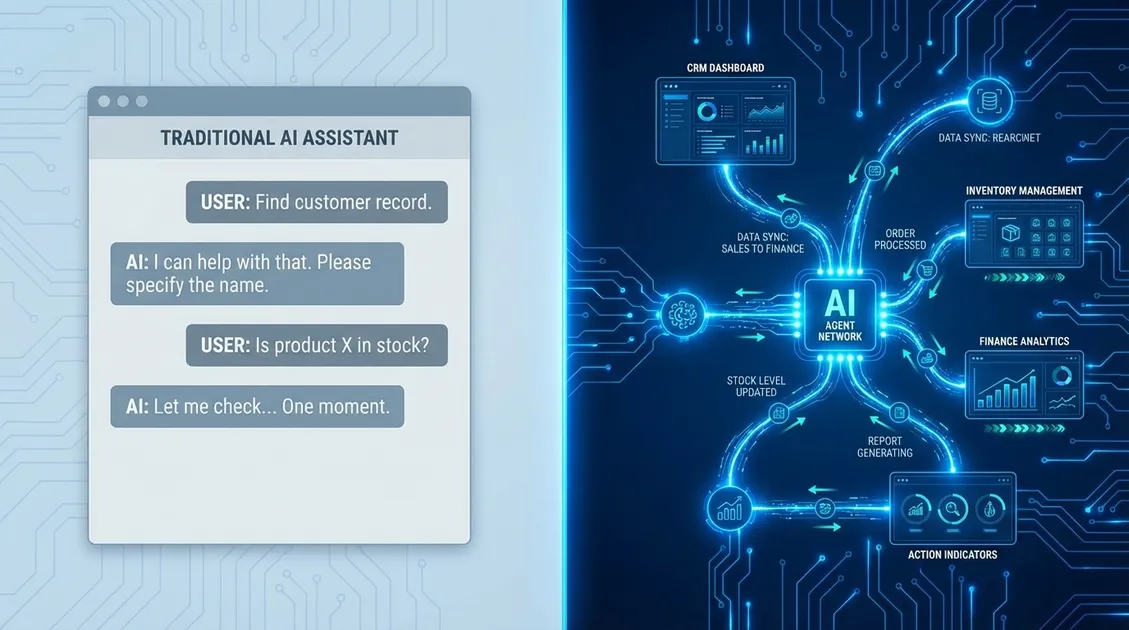
Your AI is about to stop "chatting" and start "working."
That's not hype - it's a $2 billion bet. In December 2025, Meta acquired Manus, a Singapore-based AI agent startup, for over $2 billion. The company reached $100 million in annual recurring revenue just eight months after launch. Not by building a better chatbot. By building AI that actually does things.
This acquisition is the clearest signal yet: 2026 is the year AI moves from answering questions to executing workflows. And if your business is still treating AI like a glorified search engine, you're about to get left behind.
What Is Agentic AI? (The 30-Second Answer)
Agentic AI refers to autonomous AI systems that can independently reason, plan, and execute multi-step tasks to achieve specific business goals - without requiring constant human oversight.
Unlike traditional chatbots that wait for your prompt and respond with text, AI agents:
Set goals and break them into actionable steps
Access tools like your CRM, email, databases, and APIs
Make decisions based on real-time context
Execute actions across multiple systems
Learn and adapt from outcomes
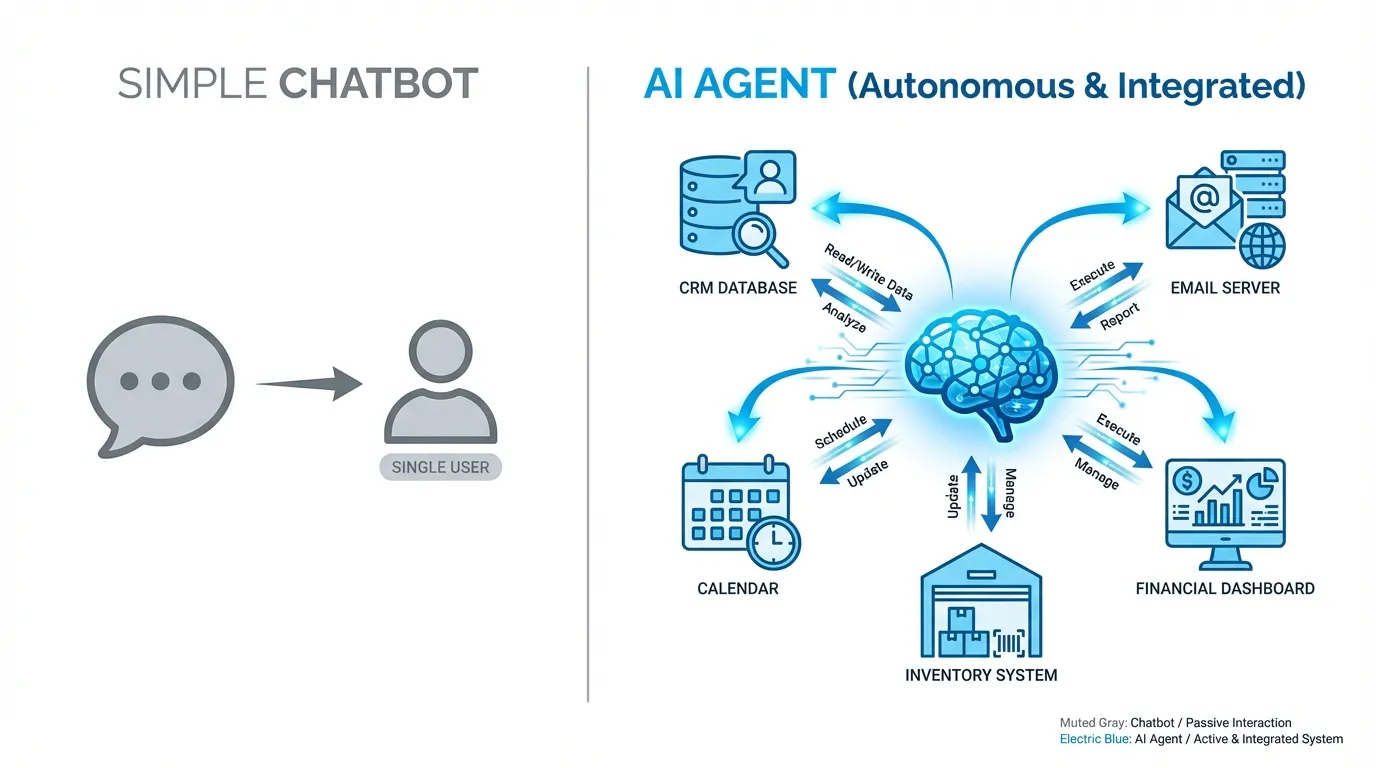
Think of it this way: a chatbot is like texting a friend for restaurant recommendations. An AI agent is like having an executive assistant who researches options, checks your calendar, makes the reservation, and sends you a calendar invite - all from a single request.
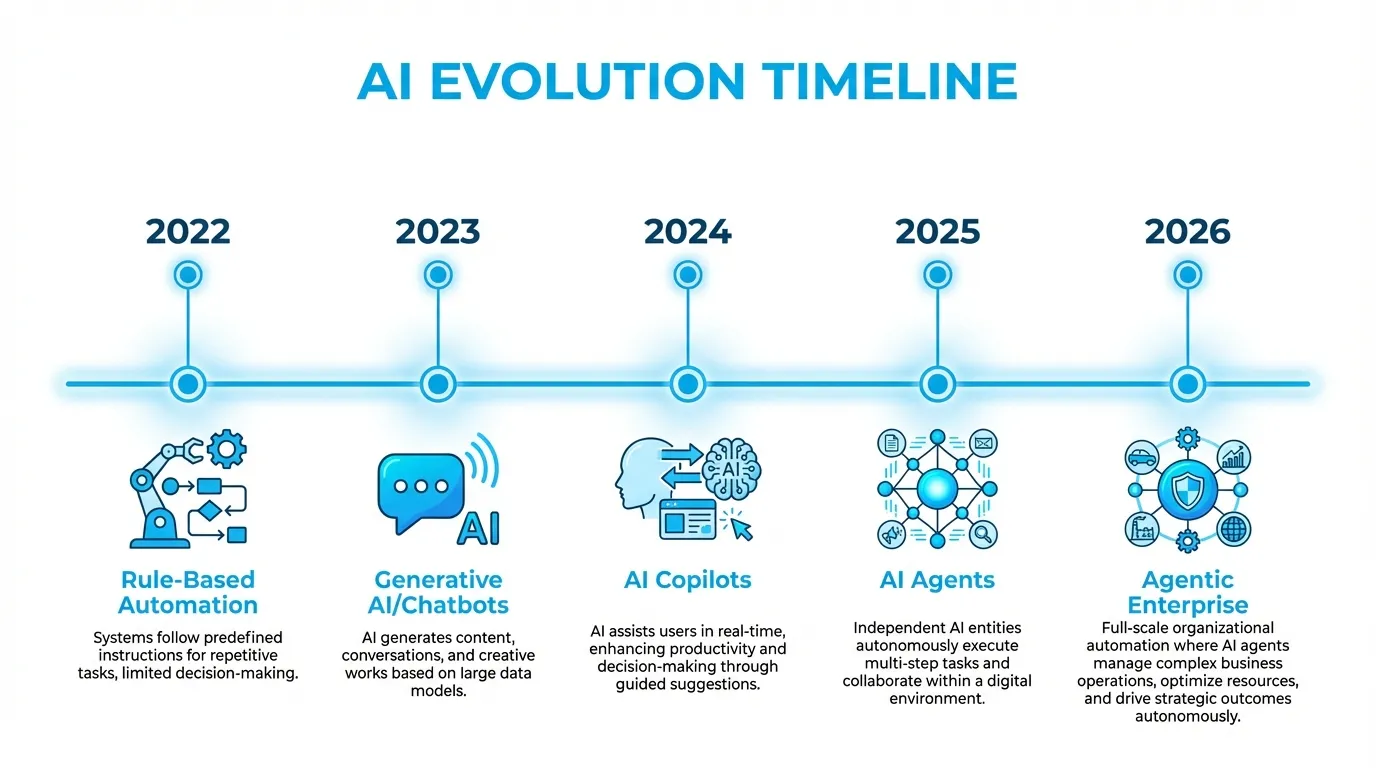
Why 2026 Is the Tipping Point for Agentic AI
The data is compelling. According to recent industry analysis:
Market Growth:
The AI agent market is projected to surge from $7.8 billion in 2025 to over $52 billion by 2030
Gartner predicts 40% of enterprise applications will embed AI agents by the end of 2026, up from less than 5% in 2025
By 2028, 33% of enterprise software will include agentic AI capabilities
Adoption Acceleration:
35% of organizations already report broad usage of AI agents
27% are actively experimenting with limited deployments
17% have rolled out AI agents company-wide
This represents a 282% jump in AI adoption year-over-year
Executive Confidence:
92% of leaders expect agentic AI to deliver measurable ROI within two years
Seven out of ten companies now say AI agents are their primary automation lever
The shift isn't theoretical. It's happening now.
The Meta-Manus Deal: What It Signals for Your Business
When Mark Zuckerberg pays $2 billion for an eight-month-old company, pay attention.
Manus wasn't acquired for its AI models—it doesn't have proprietary ones. It uses existing foundation models from providers like OpenAI, Anthropic, and others. What Manus built was something far more valuable: an execution layer that turns AI reasoning into real-world action.
The company processes over 147 trillion tokens of data and supports more than 80 million virtual computers for task execution. It can screen job candidates, plan vacations, analyze stock portfolios, conduct market research, and write code—all autonomously.
The strategic insight: Meta isn't buying intelligence. They're buying the infrastructure to make intelligence useful at scale.
For your business, this means the competitive advantage isn't in accessing AI—everyone has that now. The advantage is in how effectively you can deploy AI to actually run operations.
Chatbots vs. AI Agents: The Critical Differences
Understanding this distinction determines whether your AI investment pays off or becomes another expensive experiment.
🤖 Traditional Chatbot → 🚀 AI Agent
Input Chatbot: Waits for prompts Agent: Pursues goals autonomously
Output Chatbot: Text responses Agent: Actions across systems
Scope Chatbot: Single task Agent: Multi-step workflows
Memory Chatbot: Often stateless Agent: Persistent context
Integration Chatbot: Standalone tool Agent: Connected to your tech stack
Learning Chatbot: Static knowledge Agent: Adapts from outcomes
Decision-Making Chatbot: Follows rules Agent: Exercises judgment
Real example: A chatbot can tell you your inventory levels are low. An AI agent monitors inventory in real-time, predicts demand based on historical patterns and external factors, generates purchase orders, sends them to approved suppliers, and updates your financial systems—all before you've finished your morning coffee.
5 Agentic AI Use Cases Delivering Measurable ROI Right Now
Forget the theoretical. These are real-world applications already generating returns.
1. Autonomous Customer Support
AI agents handle tier-1 support inquiries end-to-end, resolving common issues without human intervention while intelligently escalating complex problems.
Results:
30-60% reduction in customer service costs
79% of common questions automated
24/7 coverage without staffing increases
27-40% improvement in customer satisfaction scores
2. Financial Operations Automation
Fintech company Ramp launched AI agents in July 2025 that autonomously read company policy documents, audit expenses, flag violations, and generate reimbursement approvals.
Results:
Thousands of businesses adopted within weeks
Significant reduction in manual audit hours
Improved compliance scoring
Ramp raised $500M in funding partly due to rapid agent adoption evidence
3. Supply Chain Optimization
AI agents monitor inventory levels, predict demand fluctuations, optimize routes, and coordinate with suppliers autonomously.
Results:
15-30% reduction in logistics costs
25-40% improvement in delivery speed
95%+ on-time delivery rates
30% boost in warehouse productivity
4. Healthcare Revenue Cycle Management
Healthcare organizations like Easterseals deployed specialized AI agents across billing processes—handling eligibility checks, coding, claims submission, and appeals.
Results:
Staff freed to focus on strategic improvements instead of manual transactions
Reduced claim denial rates
Accelerated revenue collection cycles
5. Sales and Marketing Automation
AI agents qualify leads, update CRM systems, schedule calls, generate campaign content, and coordinate follow-ups.
Results:
70% reduction in campaign build time
2x higher conversion rates
Customer satisfaction increased 30%
Conversions increased from 44% to 61%
The "Bounded Autonomy" Framework: How Smart Companies Deploy AI Agents
Here's the reality check that separates successful agentic AI implementations from expensive failures: autonomy without guardrails is chaos.
Deloitte's 2025 research found that while 30% of organizations are exploring agentic options and 38% are piloting solutions, only 14% have production-ready deployments. Why? Most organizations rush to maximum autonomy before building the governance infrastructure.
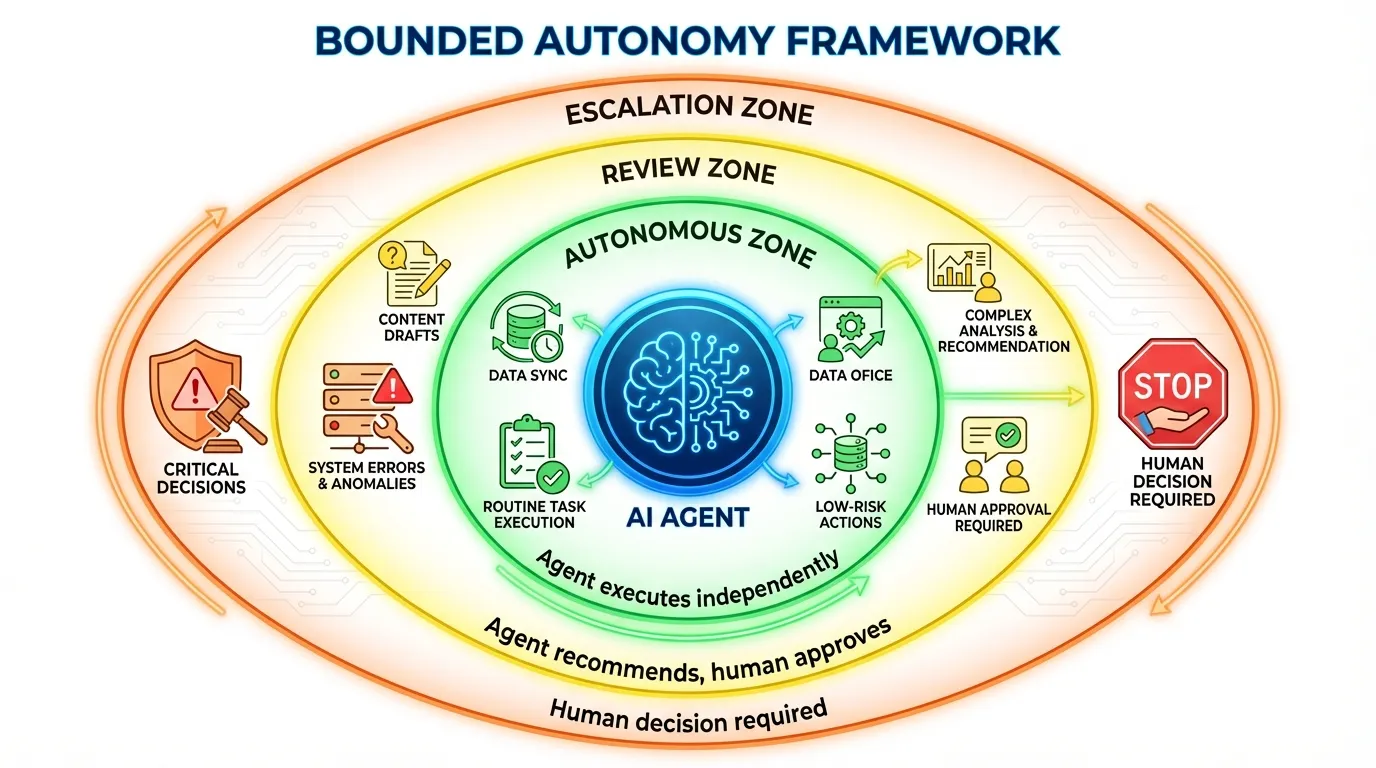
The winning approach is "bounded autonomy"—giving AI agents clear operational limits:
1. Define the Decision Boundary
Not every decision should be autonomous. Smart implementations define:
What agents CAN do without human approval
What requires human review before execution
What triggers automatic escalation
2. Build Human-in-the-Loop Checkpoints
For high-stakes decisions, agents pause and route to human owners with full context. The agent does the analysis; the human approves the action.
3. Establish Audit Trails
Every agent action should be logged, traceable, and explainable. This isn't just for compliance—it's how you improve agent performance over time.
4. Start Narrow, Scale Proven
Begin with constrained, high-volume, low-risk tasks. Prove ROI. Then expand scope incrementally.
The Data Readiness Problem (And How to Solve It)
Here's the uncomfortable truth most AI vendors won't tell you: your AI agent is only as good as the data it can access.
According to Deloitte's 2025 survey, nearly half of organizations cite data challenges as the primary barrier to AI automation:
48% struggle with data searchability
47% face data reusability issues
This is why Meta's acquisition of Manus is so strategic. Manus built systems that work despite messy enterprise data—using virtual computers and flexible execution environments to navigate real-world complexity.
For your business, data readiness means:
Inventory Your Systems Document every tool your operations touch: CRM, ERP, email, file storage, communication platforms, databases. Agents need integration points.
Assess API Availability Modern AI agents connect through APIs. Identify which systems have API access and which require workarounds.
Establish Data Governance Before agents can use data, you need clear policies on what data they can access, what they can modify, and what audit requirements apply.
Create Context Layers AI agents need business context to make good decisions. Document your workflows, policies, and decision criteria in formats agents can consume.
What This Means for Different Business Sizes
For Businesses Under $500K Revenue
The opportunity: AI agents can punch above your weight class, handling tasks that would require dedicated employees at larger companies.
Start here: Focus on customer communication agents (email triage, FAQ handling, appointment scheduling) and basic data entry automation.
Watch out for: Don't overbuild. You don't need multi-agent orchestration yet. Start with single-purpose agents that solve immediate pain points.
For Growth-Stage Businesses ($500K-$10M Revenue)
The opportunity: This is your sweet spot for competitive advantage. You have enough complexity to benefit from agentic AI but enough agility to implement faster than enterprise competitors.
Start here: Operations automation (reporting, inventory, vendor management), sales process acceleration (lead qualification, follow-up automation), and customer success workflows.
Watch out for: Integration debt. As you grow, systems multiply. Build agent infrastructure that scales—don't create automation silos.
For Established Businesses ($10M+ Revenue)
The opportunity: Multi-agent orchestration across departments. Agents that coordinate end-to-end processes spanning sales, operations, finance, and customer success.
Start here: Audit existing automation (RPA, workflow tools) for agent enhancement opportunities. Build an AI governance framework before scaling.
Watch out for: Organizational resistance. Change management matters as much as technology selection.
The Governance Gap: Why 40% of Agentic AI Projects Will Fail
Gartner predicts that over 40% of agentic AI projects will be canceled by the end of 2027 due to escalating costs, unclear business value, or inadequate risk controls.
The pattern is predictable: companies deploy agents without governance, agents make unexpected decisions, trust erodes, project gets killed.
Avoid this by building governance first:
Role-Based Access Define which agents can access which systems and what actions they're authorized to take.
Version Control Treat agent configurations like code. Track changes, test before deployment, maintain rollback capability.
Performance Monitoring Track success rates, error patterns, and outcome quality. Agents that degrade should be flagged automatically.
Compliance Integration For regulated industries, build audit and compliance requirements into agent design from day one.
Your 90-Day Agentic AI Roadmap
Days 1-30: Assessment
Audit current operations for high-volume, repetitive tasks
Identify integration requirements across your tech stack
Document decision workflows that could be automated
Benchmark current costs and time expenditure
Days 31-60: Pilot
Select one high-impact, lower-risk use case
Implement bounded autonomy with clear guardrails
Establish measurement criteria for success
Deploy with human-in-the-loop checkpoints
Days 61-90: Optimize and Expand
Analyze pilot results and ROI
Refine agent parameters based on performance data
Identify next use cases for expansion
Build governance framework for scaling
The Bottom Line
The shift from chatbots to AI agents isn't gradual—it's accelerating. Meta's $2 billion bet on Manus is just the beginning. By the end of 2026, businesses that haven't operationalized agentic AI will be competing with businesses that have AI handling their routine operations 24/7.
The good news: you don't need to be Meta to benefit. The same architectural patterns—bounded autonomy, governance-first deployment, data readiness—apply whether you're a 10-person team or a 10,000-person enterprise.
The question isn't whether agentic AI will transform business operations. It's whether you'll be leading that transformation or reacting to competitors who got there first.
Ready to move from AI that chats to AI that works?
At Dynode AI, we design and implement custom AI systems that deliver measurable efficiency gains—not just impressive demos. Our approach: Audit. Build. Implement.
https://dynode.ai/contact