On this page9 sections
The AI Opportunity Most Businesses Are Missing
Here’s a statistic that should make every business owner pay attention: 73% of businesses that adopt AI report significant improvements in efficiency within the first 90 days. Yet only 23% of small and medium businesses have moved beyond basic AI tools like ChatGPT.
That gap represents an enormous competitive advantage waiting to be claimed.
If you’re reading this, you’ve probably experimented with AI. Maybe you’ve asked ChatGPT to write emails or brainstorm ideas. That’s a start, but it’s like using a smartphone only to make phone calls. The real power lies in what you haven’t explored yet.
This guide will show you exactly how AI can optimize your business, which processes to target first, and how to implement AI systems that actually deliver measurable ROI.
What Does “AI Optimization” Actually Mean?
Before diving into tactics, let’s clarify what we’re really talking about.
AI business optimization means using artificial intelligence to make your operations faster, more accurate, less expensive, or more scalable. It’s not about replacing humans; it’s about amplifying what your team can accomplish.
Think of AI as a multiplier. If your best employee can process 50 customer inquiries per day, AI can help them handle 200 while maintaining quality. If your sales team spends 4 hours daily on data entry, AI can reduce that to 20 minutes.
The optimization happens in three primary ways:
Automation replaces repetitive manual tasks with AI-powered systems that run continuously without fatigue or errors.
Augmentation enhances human decision-making by providing insights, recommendations, and analysis that would take humans hours or days to compile.
Acceleration speeds up processes that currently create bottlenecks, enabling faster response times, shorter project cycles, and quicker time-to-market.
7 Ways AI Can Optimize Your Business Today
Let’s get specific. Here are seven proven areas where AI delivers measurable business optimization, ranked by typical implementation ease and ROI.
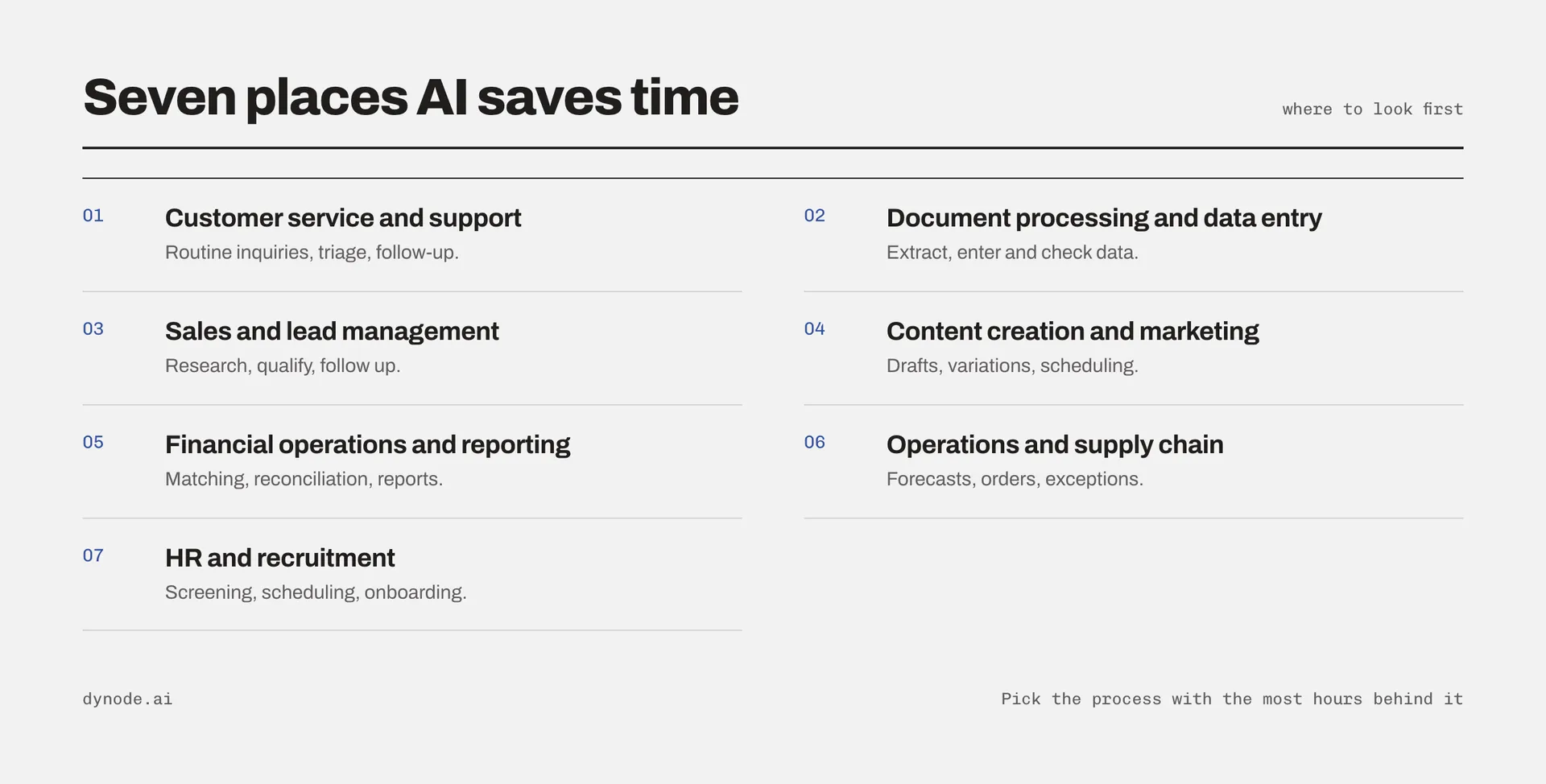
1. Customer Service and Support
The Problem: Customer support is expensive, inconsistent, and often frustrating for both customers and staff. Peak times overwhelm your team while off-hours leave customers waiting.
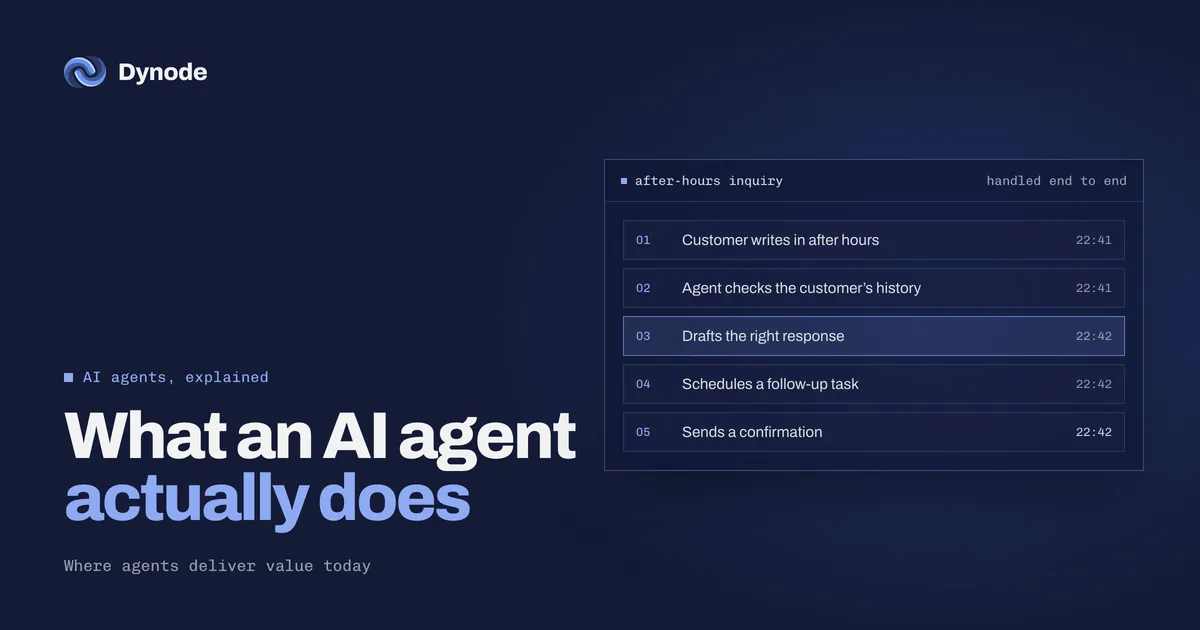
The AI Solution: AI inside your help desk can triage and answer routine inquiries at any hour. Unlike the clunky chatbots of the past, modern AI understands context and remembers conversation history, and anything it isn’t sure about goes to a person.
Real Results:
Response times drop from hours to seconds
Support costs decrease by 30–50%
Customer satisfaction often improves (no more hold times)
Human agents focus on complex, high-value interactions
Implementation Complexity: Low to Medium
Typical ROI Timeline: 30–60 days
2. Document Processing and Data Entry
The Problem: Your team spends countless hours extracting data from documents, entering information into systems, and verifying accuracy. It’s tedious, error-prone, and expensive.
The AI Solution: AI document processing can read invoices, contracts, forms, and reports, then extract relevant data and enter it into your systems automatically. Modern AI achieves 95%+ accuracy, often exceeding human performance.
Real Results:
Processing time reduced by 80–90%
Error rates drop by 60–70%
Staff redirected to higher-value work
Faster turnaround for customers and partners
Implementation Complexity: Medium
Typical ROI Timeline: 60–90 days
3. Sales and Lead Management
The Problem: Your sales team wastes time on unqualified leads, misses follow-ups, and lacks insights into which prospects are most likely to convert.
The AI Solution: AI-powered CRM enhancement scores leads automatically, predicts which prospects are ready to buy, suggests optimal outreach timing, and even drafts personalized follow-up messages.
Real Results:
Lead conversion rates increase 20–40%
Sales cycle length decreases by 15–25%
Reps spend 50% more time selling, less time on admin
Pipeline forecasting becomes significantly more accurate
Implementation Complexity: Medium
Typical ROI Timeline: 60–90 days
4. Content Creation and Marketing
The Problem: Creating quality content is time-consuming and expensive. Maintaining consistent output across channels feels impossible without a large team.
The AI Solution: AI content tools can draft blog posts, social media content, email campaigns, and marketing copy. While human oversight remains essential, AI handles the heavy lifting of first drafts and variations.
Real Results:
Content production increases 3-5x
Time spent on first drafts drops by 70%
Consistent brand voice across all channels
A/B testing at scale becomes feasible
Implementation Complexity: Low
Typical ROI Timeline: 14–30 days
5. Financial Operations and Reporting
The Problem: Month-end closes take forever. Financial analysis requires manual spreadsheet work. Catching anomalies or fraud relies on human vigilance.
The AI Solution: AI can automate reconciliations, generate financial reports, flag unusual transactions, forecast cash flow, and even assist with compliance documentation.
Real Results:
Month-end close time reduced by 50–70%
Real-time financial visibility
Anomaly detection catches issues humans miss
Finance team shifts from data compilation to strategic analysis
Implementation Complexity: Medium to High
Typical ROI Timeline: 90–120 days
6. Operations and Supply Chain
The Problem: Inventory management is a constant balancing act. Stockouts cost sales while overstock ties up capital. Demand forecasting feels like guesswork.
The AI Solution: AI analyzes historical data, market trends, and external factors to predict demand accurately. It can automatically adjust reorder points, optimize warehouse operations, and identify supply chain risks before they become problems.
Real Results:
Inventory carrying costs reduced by 20–35%
Stockout incidents decrease by 50–80%
Demand forecast accuracy improves by 30–50%
Supply chain disruptions identified weeks earlier
Implementation Complexity: High
Typical ROI Timeline: 90–180 days
7. HR and Recruitment
The Problem: Hiring is slow, expensive, and often ineffective. Screening resumes takes hours. Great candidates slip through while mediocre ones consume interview time.
The AI Solution: AI can screen resumes against job requirements, identify promising candidates, schedule interviews, and even conduct preliminary assessments. It also helps with onboarding, policy questions, and employee engagement analysis.
Real Results:
Time-to-hire reduced by 40–60%
Screening time drops by 75%
Quality of hire improves (better matching)
HR team focuses on culture and strategic initiatives
Implementation Complexity: Medium
Typical ROI Timeline: 60–90 days
How to Calculate AI ROI for Your Business
Before investing in AI optimization, you need to understand the potential return. Here’s a practical framework.
Step 1: Identify Your Target Process
Choose a specific process that is repetitive, time-consuming, prone to errors, or creating bottlenecks. The more hours your team spends on it, the greater the optimization potential.
Step 2: Calculate Current Costs
Labor Cost = Hours per week × Hourly rate × 52 weeks
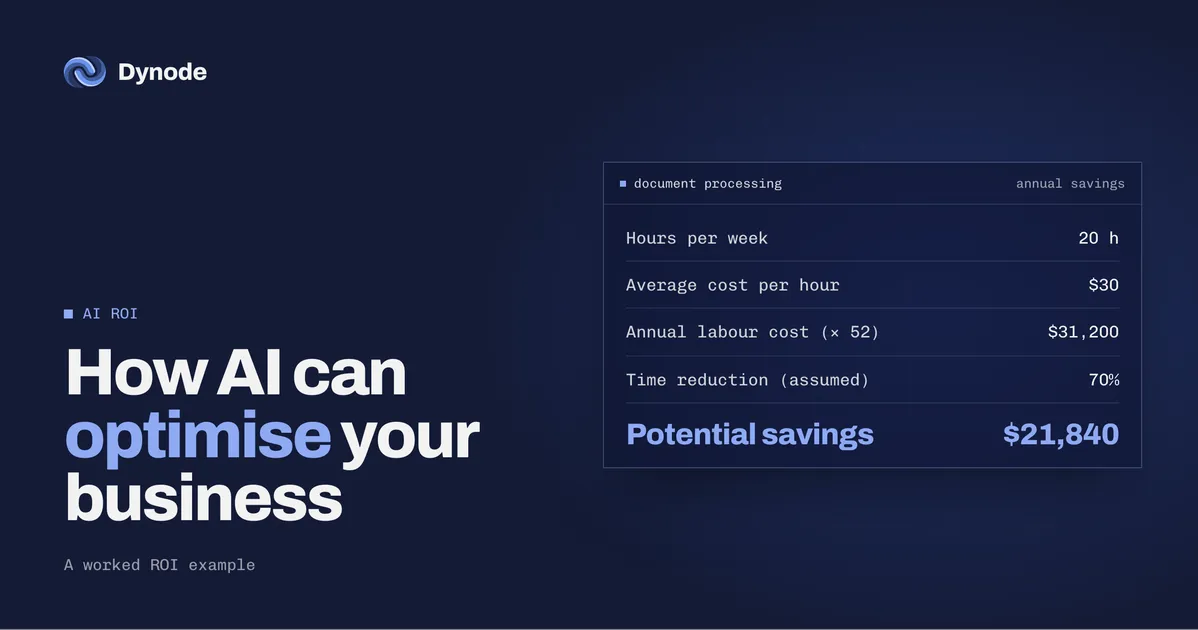
For example: If your team spends 20 hours weekly on document processing at an average $30/hour:
Annual labor cost: 20 × $30 × 52 = $31,200
Don’t forget to include error costs (corrections, customer complaints), opportunity costs (what could your team do instead?), and overhead (tools, management time).
Step 3: Estimate AI Impact
Based on the results data above, estimate conservative improvement percentages. For document processing, assume 70% time reduction.
Potential savings: $31,200 × 0.70 = $21,840 annually
Step 4: Factor in AI Costs
Include implementation costs (one-time), ongoing subscription or maintenance, and training time. Subtract these from savings for net ROI.
Step 5: Consider Intangible Benefits
Some benefits resist easy quantification: faster customer response, improved employee satisfaction (less tedious work), competitive advantage, and scalability without proportional headcount increases.
The AI Implementation Roadmap
Knowing where AI can help is step one. Actually implementing it successfully requires a structured approach.
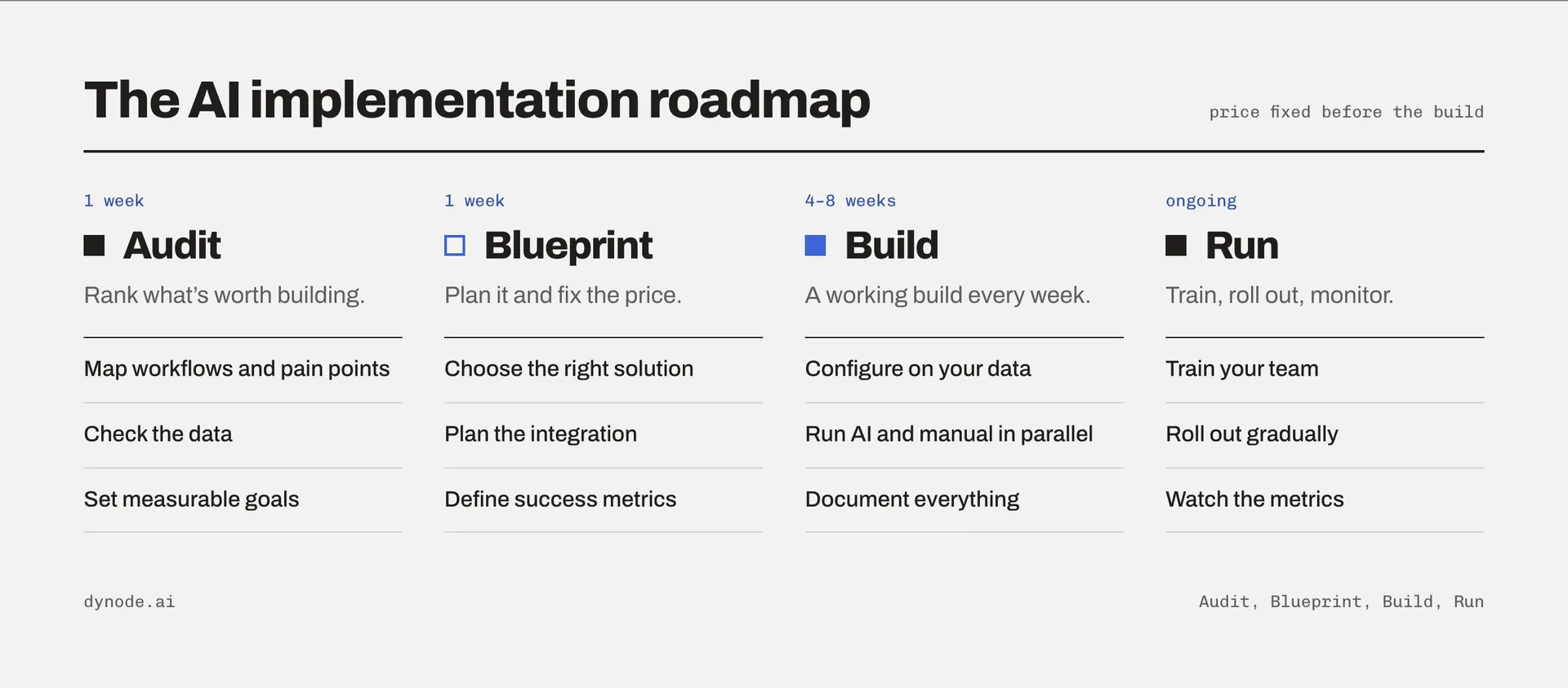
Phase 1: Audit (1 week)
Audit your current processes. Map out workflows, identify pain points, and quantify time and cost for each process. Determine which processes meet the criteria for AI optimization.
Evaluate your data. AI systems need data to function. Assess whether you have sufficient historical data, clean data, and accessible data for the processes you want to optimize.
Set clear objectives. Define specific, measurable goals. “Improve efficiency” is vague. “Reduce document processing time by 60% within 90 days” is actionable.
Phase 2: Blueprint (1 week)
Select the right solution. Match AI capabilities to your specific needs. Off-the-shelf tools work for some applications; custom solutions may be necessary for others.
Plan the integration. Determine how AI will connect with your existing systems. Integration complexity is often underestimated and can make or break implementation success.
Define success metrics. Establish baseline measurements and target improvements. Plan how you’ll track progress.
Phase 3: Build (4–8 weeks)
Configure and customize. Set up the AI system according to your specifications. Configure rules, train models on your data, and establish workflows.
Test thoroughly. Run parallel processes (AI and manual) to validate accuracy and identify issues before full deployment.
Document everything. Create clear documentation for how the system works, how to troubleshoot common issues, and how to make adjustments.
Phase 4: Run (ongoing)
Train your team. People who will use the AI system need to understand how it works, what it can and cannot do, and how their role changes.
Roll out gradually. Start with a subset of processes or a pilot team. Expand as you build confidence and work out kinks.
Monitor closely. Watch performance metrics daily during initial deployment. Be prepared to make rapid adjustments.
Phase 5: Optimize (Ongoing)
Gather feedback. Regularly collect input from users and customers about how the AI system is performing.
Refine continuously. AI systems improve with feedback and additional data. Plan for ongoing optimization, not just one-time implementation.
Measure and report. Track ROI and share results. This builds organizational buy-in for future AI initiatives.
Common AI Implementation Mistakes to Avoid
Learning from others’ failures is cheaper than making your own. Here are the most frequent pitfalls.
Starting Too Big
Ambitious organization-wide AI transformations often stall or fail. Start with one process, prove success, then expand. Quick wins build momentum and organizational support.
Ignoring Change Management
Technology is the easy part. Getting people to actually use new systems and adapt their workflows is hard. Invest in training, communication, and addressing concerns upfront.
Underestimating Data Requirements
AI needs data. If your data is scattered, inconsistent, or incomplete, you’ll spend more time on data preparation than AI implementation. Assess data readiness early.
Choosing Technology Before Strategy
Don’t start by asking “What AI tool should we buy?” Start by asking “What problem are we solving?” The right tool depends entirely on the specific use case.
Expecting Perfection Immediately
AI systems improve over time. Initial accuracy of 85% might feel disappointing, but it often beats human performance and will improve with feedback. Set realistic expectations.
Neglecting Maintenance
AI systems are not “set and forget.” They require ongoing monitoring, retraining, and adjustment. Budget for maintenance from the start.
Is Your Business Ready for AI Optimization?
Not every business is equally positioned to benefit from AI. Here’s a quick readiness assessment.
You’re ready if you have:
Repetitive processes consuming significant staff time
Digital data (not just paper records)
Clear pain points you want to solve
Leadership willing to invest in change
Staff open to adopting new tools
You may need preparation if:
Processes are undefined or chaotic
Data is primarily paper-based or siloed
There’s strong organizational resistance to change
Budget for implementation is severely limited
IT infrastructure is outdated
Red flags that suggest waiting:
Major organizational changes already underway
No clear business problem to solve
Data is extremely sensitive with regulatory restrictions
Core business model is in question
The Competitive Imperative
Here’s the uncomfortable truth: AI optimization isn’t optional anymore. It’s a competitive necessity.
Businesses that delay AI adoption face increasing disadvantages. Their competitors who embrace AI will operate faster, at lower cost, and with better customer experiences. The gap will widen over time.
The good news? You don’t need to become a technology company. You don’t need an army of data scientists. You need a clear strategy, the right partners, and willingness to evolve.
The businesses that thrive in the next decade won’t necessarily be the largest or the best-funded. They’ll be the ones that most effectively leverage AI to amplify human capabilities.
Your Next Step
If you’ve read this far, you’re already ahead of most business owners who dismiss AI as hype or assume it’s only for large enterprises.
The question isn’t whether AI can optimize your business. It’s which processes to optimize first and how to implement effectively.
That’s where Dynode starts.
Our AI audit takes one week and has a fixed price. We read your workflows, data and code, rank which processes are worth optimizing, and tell you plainly when the answer is don’t build. You keep the process map, the ranking and the reasoning either way.
Start with the one-week AI audit →
Or tell us what you’re building. A few lines is enough, and we reply within one business day.
Dynode is an AI-first software studio. We take working prototypes to production, build SaaS platforms and put AI inside the tools your team already uses. The build price is fixed before we write code, and you own the code.