On this page5 sections
Here’s a statistic that should keep every business owner up at night: according to RAND Corporation research, over 80% of AI projects fail-twice the failure rate of traditional IT projects. And it’s getting worse, not better. An S&P Global survey found that 42% of companies abandoned most of their AI initiatives in 2025, up from just 17% in 2024.
Yet the businesses that get AI right are seeing remarkable returns: $3.70 back for every dollar invested, 20+ hours saved per month, and productivity gains between 27% and 133%.
So what separates the winners from the 70% that fail? The research points to clear patterns. The failures share common mistakes. The successes share common strategies. This post breaks down both.
The Real Reasons AI Projects Fail
Most articles blame “bad data” or “lack of AI talent” for project failures. Those are factors, but they’re symptoms, not root causes. The real problems start much earlier.
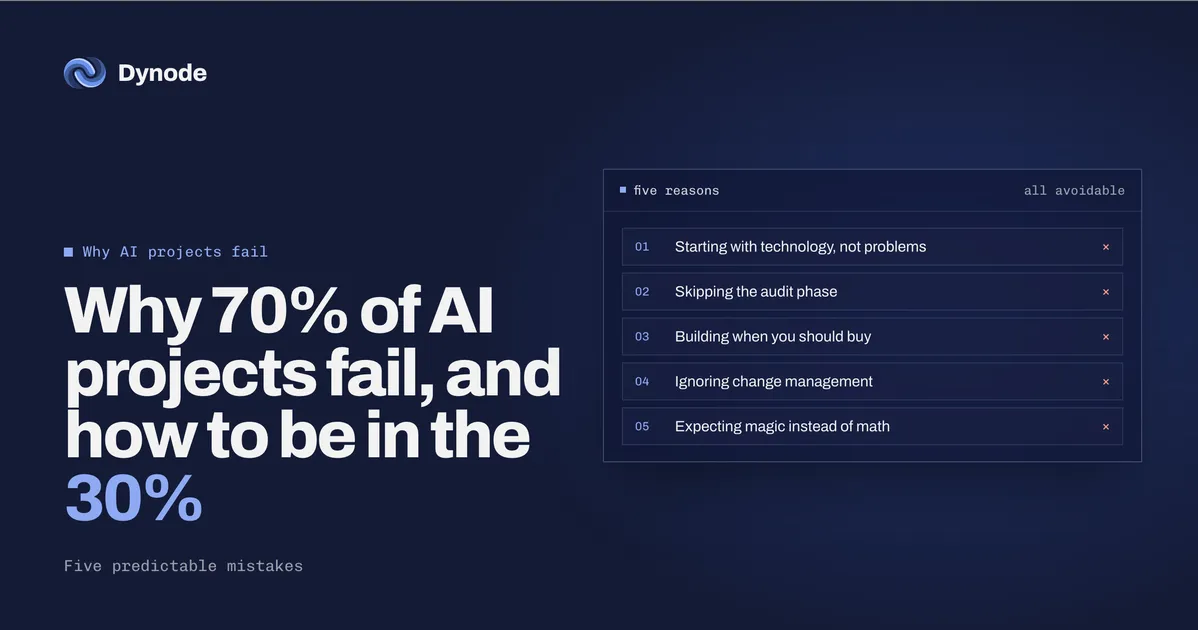
1. Starting with Technology Instead of Problems
The most common mistake we see: a business owner reads about ChatGPT, gets excited, and asks “How can we use AI?” That question is backwards.
Successful AI projects start with a specific, measurable business problem. Not “improve customer service” but “reduce average response time from 4 hours to 30 minutes.” Not “automate marketing” but “cut the 15 hours per week we spend on social media scheduling.”
McKinsey’s 2025 AI survey confirms this: organizations reporting significant financial returns are twice as likely to have redesigned end-to-end workflows before selecting any AI technology.
2. Skipping the Audit Phase
Many businesses jump straight to buying AI tools without understanding their current state. This is like hiring a contractor to renovate your house without first checking the foundation.
A proper AI readiness audit examines your existing processes, data quality, team capabilities, and technology infrastructure. It identifies which problems are actually solvable with AI versus which ones need operational fixes first. According to Informatica’s CDO Insights 2025 survey, the top obstacles to AI success are data quality and readiness (43%), lack of technical maturity (43%), and shortage of skills (35%). An audit catches these issues before you’ve invested $50,000 in the wrong solution.
3. Building When You Should Buy (and Vice Versa)
MIT research revealed something surprising: purchasing AI tools from specialized vendors succeeds about 67% of the time, while internal builds succeed only about 33% of the time. Yet many businesses, especially in regulated industries, default to building custom solutions.
The decision isn’t about capability-it’s about fit. Off-the-shelf tools work well for common use cases: customer service chatbots, email automation, scheduling, basic data analysis. Custom solutions make sense when you have truly unique processes or data that generic tools can’t handle.
For most small businesses, the answer is usually “buy first, customize later.”
4. Ignoring Change Management
AI tools don’t fail in the lab-they fail in the office. Research from NTT DATA highlights that employee trust is one of the most overlooked factors in AI adoption. If your team doesn’t understand how to use AI tools, doesn’t trust their outputs, or feels threatened by them, even the best technology will gather dust.
A 2023 study found that 52% of workers were more concerned than excited about AI, up from 37% in 2021. That skepticism doesn’t disappear when you deploy a new tool-it has to be addressed through training, transparency, and involvement.
5. Expecting Magic Instead of Math
AI vendors love to show the highlight reel: 10x productivity gains, millions in savings, transformed businesses. The reality is more nuanced.
Realistic AI ROI for small businesses looks like saving 20+ hours per month, reducing costs by $500-$2,000 monthly, and seeing initial returns within 60–90 days-not overnight. Businesses that set realistic expectations stick with their implementations long enough to see results. Those expecting magic give up after two weeks.
What the Successful 30% Do Differently
The patterns among successful AI implementations are remarkably consistent. Here’s what works.
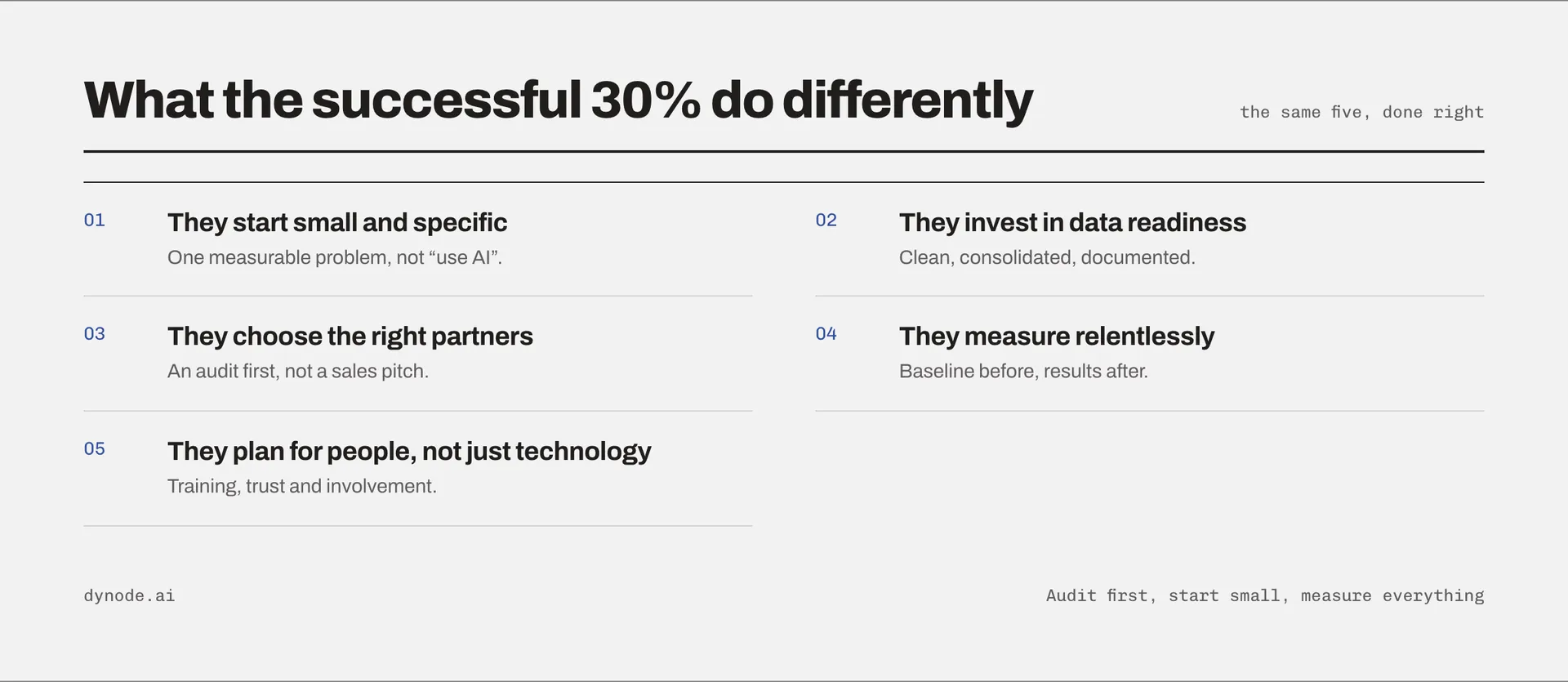
They Start Small and Specific
Successful businesses don’t try to “implement AI”-they solve one specific problem first. A restaurant automates reservation confirmations. An accounting firm automates document intake. A marketing agency automates social media scheduling.
These narrow pilots accomplish two things: they deliver quick wins that build organizational confidence, and they teach you how AI works in your specific environment before you scale.
They Invest in Data Readiness
The old saying that 80% of machine learning work is data preparation still holds true. Winning programs allocate 50–70% of their timeline and budget for data readiness-extraction, normalization, governance, and quality control.
For small businesses, this doesn’t mean hiring a data science team. It means cleaning up your CRM, standardizing your file naming conventions, consolidating your customer data, and documenting your processes before you add AI on top.
They Choose the Right Partners
MIT’s research is clear: specialized vendor partnerships succeed at twice the rate of internal builds. But not all partners are equal.
The right AI partner for a small business understands your constraints: limited budgets, small teams, and the need for fast ROI. They won’t propose a $500,000 custom solution when a $10,000 implementation would solve your problem. They’ll start with an audit, not a sales pitch.
They Measure Relentlessly
Research shows that companies measuring ROI for their AI initiatives are 1.7 times more likely to achieve their goals. Successful businesses track specific metrics from day one: time saved per task, error rates before and after, customer response times, cost per transaction.
This measurement discipline serves two purposes. First, it proves value and justifies continued investment. Second, it identifies what’s working and what needs adjustment. AI implementation isn’t set-and-forget-it requires ongoing optimization.
They Plan for People, Not Just Technology
The most successful AI implementations include training budgets, clear communication plans, and gradual rollouts. They involve employees in the selection process. They address the “will this replace me?” question directly: AI handles the repetitive tasks so humans can focus on work that requires creativity, judgment, and relationships.
Interestingly, U.S. Chamber of Commerce data shows that 82% of small businesses using AI actually increased their workforce. AI typically creates capacity for growth, not headcount reductions.
A Realistic AI Implementation Roadmap
Here’s what a realistic first AI project looks like:
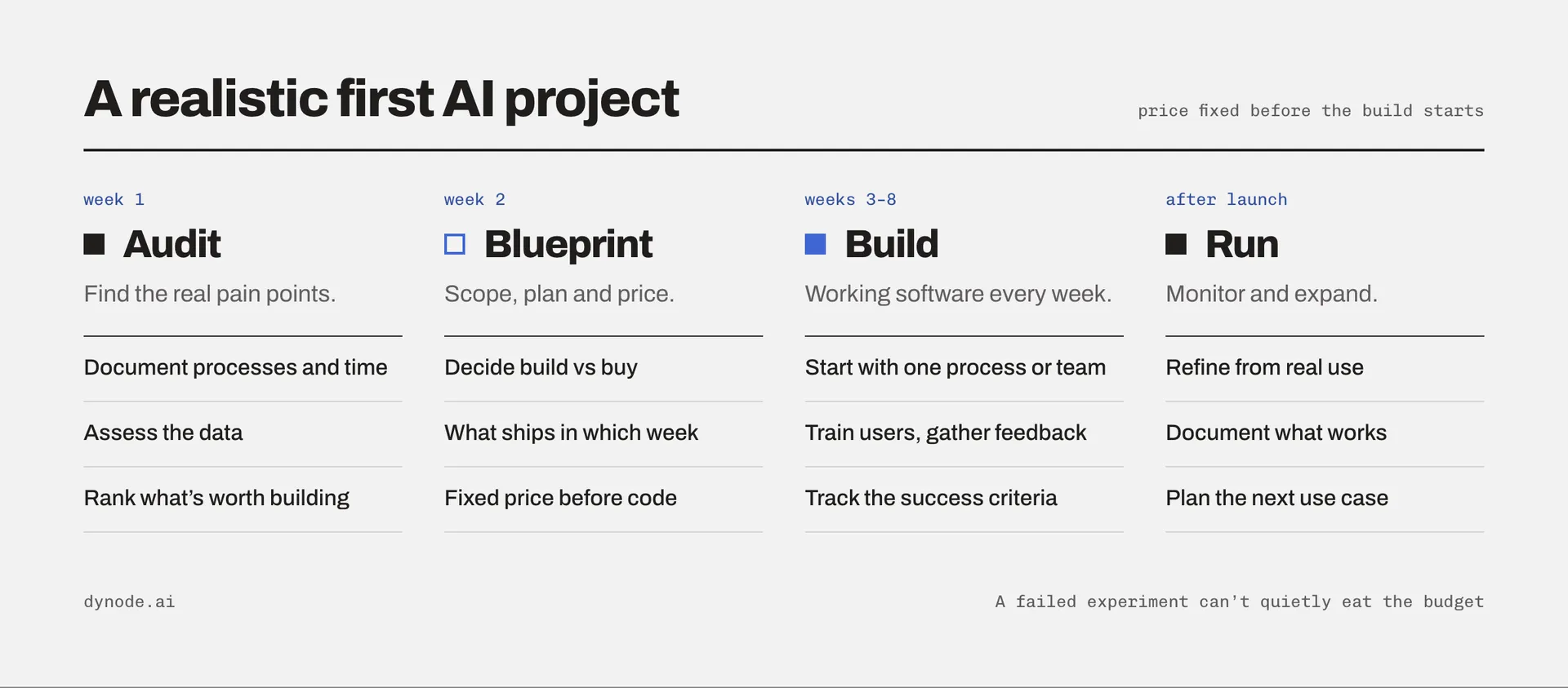
Week 1: Audit. Identify your biggest operational pain points. Document current processes and time spent. Assess data quality and availability. Rank what’s worth building, and be ready to hear that the answer is don’t build.
Week 2: Blueprint. Match problems to solutions and decide build vs. buy. Write down what’s in scope, what ships in which week and how success will be measured, then fix the price before any code is written.
Weeks 3–8: Build. Start with a limited scope: one process, one team, or one location. See a working build every week. Train users, gather feedback, and track metrics against the success criteria.
After launch: Run and expand. Monitor the system, refine it from real-world performance, document what works, and plan the next use case.
This puts a working system in front of your team within weeks, and because the price is fixed before the build starts, a failed experiment can’t quietly eat your budget.
The Bottom Line
The 70–80% AI failure rate isn’t inevitable-it’s the result of predictable mistakes. Businesses fail when they chase technology without clear problems, skip proper assessment, underinvest in their people, and expect overnight transformation.
The 30% that succeed share a different approach: start with specific problems, audit before implementing, choose the right partners, measure everything, and invest in people alongside technology.
For growing teams, the stakes are particularly high. You don’t have enterprise budgets to absorb failed experiments. But you also have advantages: you can move faster, adapt more easily, and implement changes without navigating corporate bureaucracy.
The businesses seeing 20+ hours saved per month and $3.70 returned for every dollar invested aren’t doing anything magical. They’re being disciplined about a proven process: audit first, start small, measure everything, and scale what works.
That’s how you end up in the 30%.
Ready to Start Your AI Journey the Right Way?
At Dynode, every engagement starts with a one-week AI audit at a fixed price. We read your workflows, data and code, rank the highest-impact opportunities, and tell you plainly when the answer is don’t build, before recommending any solution.
Start with the one-week AI audit and find out where AI can deliver real ROI for your business.