
AI Agents Explained: What Small Business Owners Need to Know in 2026
68% of small businesses now use AI regularly. Discover what AI agents actually are, where they work best, and how to evaluate if they're right for your business.
If you've been following AI news lately, you've probably noticed a new term showing up everywhere: AI agents. Unlike the chatbots and AI assistants that dominated 2023 and 2024, AI agents represent something fundamentally different. They don't just answer questions or generate content. They take action.
According to a 2025 Intuit QuickBooks survey, 68% of small businesses now report using AI regularly, up 42% from the previous year. And about 1 in 10 business owners already identify as early adopters of agentic AI specifically. The shift from experimental to operational is happening faster than most predicted.
But here's the challenge: the term "AI agent" gets thrown around loosely, and the technology is evolving so quickly that it's hard to separate practical applications from hype. This guide breaks down what AI agents actually are, how they differ from other AI tools, and where they're delivering real value for businesses like yours.
What Is an AI Agent, Exactly?
An AI agent is software that can observe its environment, make decisions, and take actions to accomplish goals with minimal human intervention. That last part is key. Traditional AI tools respond to prompts. AI agents pursue objectives.
Think of the difference this way: A chatbot waits for you to ask a question, then provides an answer. An AI agent might notice that a customer inquiry came in after hours, access your CRM to check the customer's history, draft an appropriate response, schedule a follow-up task, and send a confirmation, all without you asking it to do any of those individual steps.
BCG describes AI agents as having three core capabilities: they observe (gathering information from their environment), plan (deciding the best course of action), and act (executing tasks using connected systems). This observe-plan-act cycle allows agents to handle multi-step workflows that previously required human judgment at every decision point.
The practical implication? Tasks that used to require your attention throughout the entire process can now run in the background while you focus on higher-value work.
AI Agents vs. Chatbots vs. Automation: Understanding the Differences
The AI landscape is crowded with overlapping terms, so let's clarify how these technologies differ:
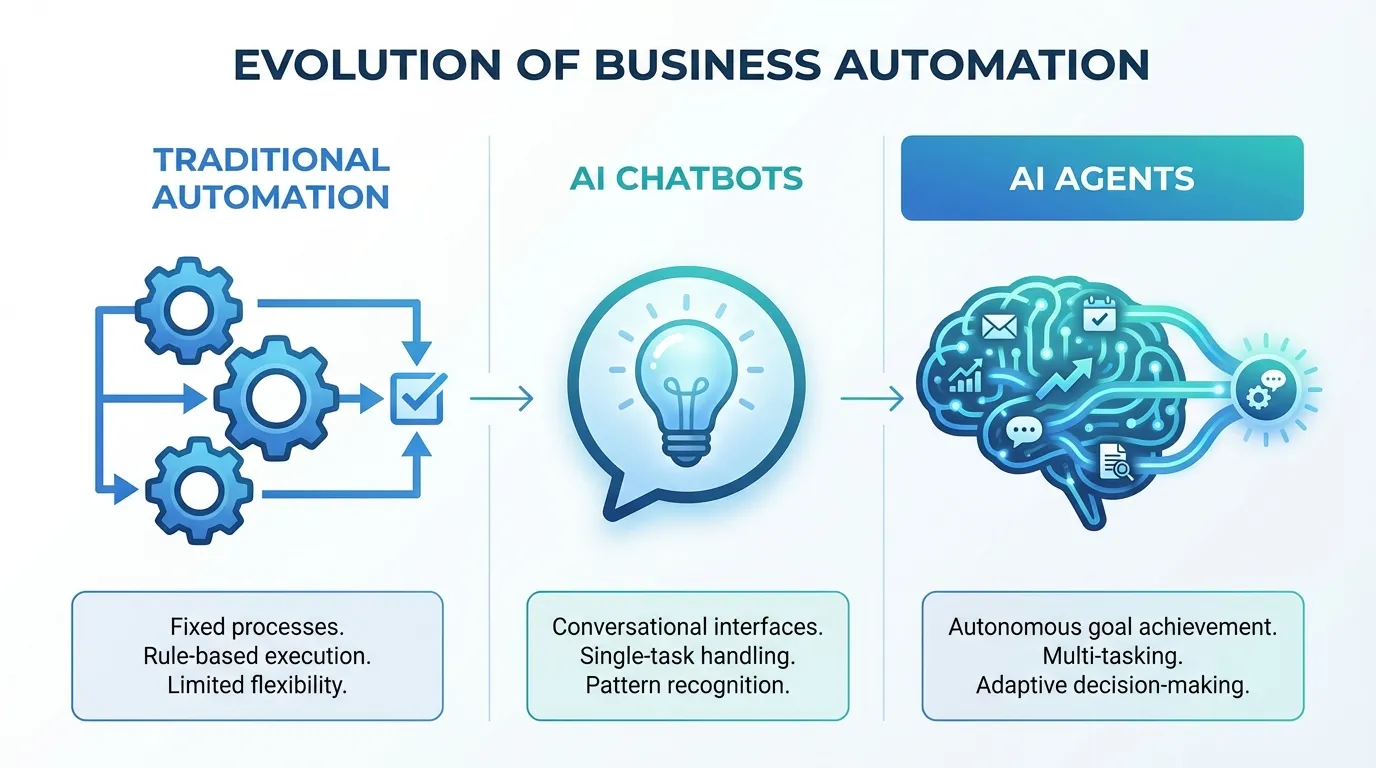
Traditional automation (like Zapier or basic RPA) follows rigid if-then rules. If a form is submitted, send an email. If a payment is received, update a spreadsheet. These tools are powerful but inflexible. They can't handle exceptions or adapt to new situations without being reprogrammed.
AI assistants and chatbots understand natural language and can generate responses, but they typically operate on a single-task basis. You ask a question, you get an answer. They don't chain together multiple actions or pursue goals across systems.
AI agents combine the language understanding of chatbots with the action-taking capability of automation, plus something new: reasoning. They can interpret ambiguous situations, decide between multiple possible approaches, and adjust their behavior based on results.
As IBM explains, agentic AI systems can autonomously plan, reason, and execute complex tasks. They can call on external tools, access databases, collaborate with other agents, and adapt when things don't go as expected. This makes them suitable for workflows that traditional automation simply can't handle.
Where AI Agents Are Delivering Real Value Today
The hype around AI agents is significant, but so are the real-world applications. Here's where businesses are seeing measurable results:
Customer Service and Support
This is currently the most mature application. AI agents can handle inquiries across voice, email, chat, and text, 24 hours a day. But unlike earlier chatbots that could only answer FAQs, today's agents can access customer records, process returns, schedule appointments, update account information, and escalate complex issues to human staff with full context already gathered.
Lyft implemented AI agents using Anthropic's Claude and reported cutting resolution times by 87% through smart AI-human handoffs. For small businesses, the benefit isn't necessarily replacing customer service staff. It's providing coverage outside business hours and handling routine inquiries so your team can focus on complex problems.
Administrative Tasks and Operations
According to a KPMG report, administrative duties are the top use case for AI agents, cited by 60% of respondents. This includes scheduling, document processing, data entry, email management, and internal knowledge retrieval.
A law firm example illustrates this well: attorneys using AI agents that sit inside Word or Outlook can automate contract reviews, document generation, and communication workflows. The agents access company data and historical records to understand what's typically done, then handle routine tasks while flagging anything unusual for human review.
Sales and Lead Management
AI agents can qualify leads, research prospects, personalize outreach, schedule follow-ups, and update CRM records automatically. One freight brokerage company deployed an AI agent that researches available loads, contacts potential customers, and schedules follow-up calls. The result: 30% more loads booked per week with no additional headcount.
For small sales teams, this type of agent acts as a force multiplier. It handles the research and administrative overhead that typically consumes selling time.
Financial Operations
Intuit's AI agents in QuickBooks can now categorize transactions, reconcile accounts, generate reports, and flag anomalies automatically. For businesses that previously spent hours on bookkeeping, these agents handle the routine work while surfacing insights that might otherwise go unnoticed.
More sophisticated applications include fraud detection, expense analysis, and cash flow forecasting. Mastercard uses AI agents to scan transaction data and detect irregularities within milliseconds. While that's enterprise-scale, similar capabilities are trickling down to small business tools.
The Current Limitations (What the Hype Doesn't Tell You)
AI agents are impressive, but they're not magic. Understanding the limitations is essential for setting realistic expectations.
Accuracy isn't perfect. Research from Anthropic and Carnegie Mellon has found that AI agents still make too many mistakes for businesses to rely on them for high-stakes processes involving significant money or risk. They work best for tasks where occasional errors are recoverable, not catastrophic.
They need oversight. The term "autonomous" can be misleading. Effective AI agent deployments include human checkpoints for reviewing decisions, approving actions above certain thresholds, and catching edge cases the agent wasn't trained to handle. PwC recommends mapping out step-by-step where agents own the work, where people do, and where oversight takes place.
Data quality matters enormously. AI agents are only as good as the information they can access. If your CRM is outdated, your documents are disorganized, or your processes aren't well-defined, agents will struggle. Data readiness remains one of the top obstacles to AI success.
Security is a real concern. Agents that can take action also introduce new risks. Prompt injection attacks, where malicious input manipulates agent behavior, are an emerging security challenge. Any agent deployment should include safeguards against unauthorized actions.

How to Evaluate Whether AI Agents Make Sense for Your Business
Not every business is ready for AI agents, and not every problem needs them. Here's a framework for evaluating fit:
Look for repetitive, multi-step workflows. AI agents excel at tasks that follow patterns but require judgment at multiple points. If a workflow is simple enough for basic automation, use that instead. If it requires deep expertise and creativity throughout, it probably needs a human. The sweet spot is in between: processes with clear goals, defined steps, but enough variation that rigid rules don't work.
Assess your data readiness. Before considering AI agents, ask: Is our customer data clean and current? Are our processes documented? Do our systems integrate with each other? If the answer to these questions is no, you may need to address foundational issues first.
Start with low-risk, high-frequency tasks. The best first use cases are tasks that happen often (providing lots of learning opportunities), don't involve irreversible consequences, and free up significant time. After-hours customer inquiries, appointment scheduling, and data entry are common starting points.
Consider buy vs. build carefully. MIT research shows that purchasing AI solutions from specialized vendors succeeds about 67% of the time, while internal builds succeed only about 33%. Most small businesses should look for AI agent capabilities built into tools they already use (like QuickBooks, HubSpot, or their customer service platform) rather than building custom solutions.
What's Coming Next: AI Agents in 2026 and Beyond
The AI agent landscape is evolving rapidly. Here are the trends to watch:
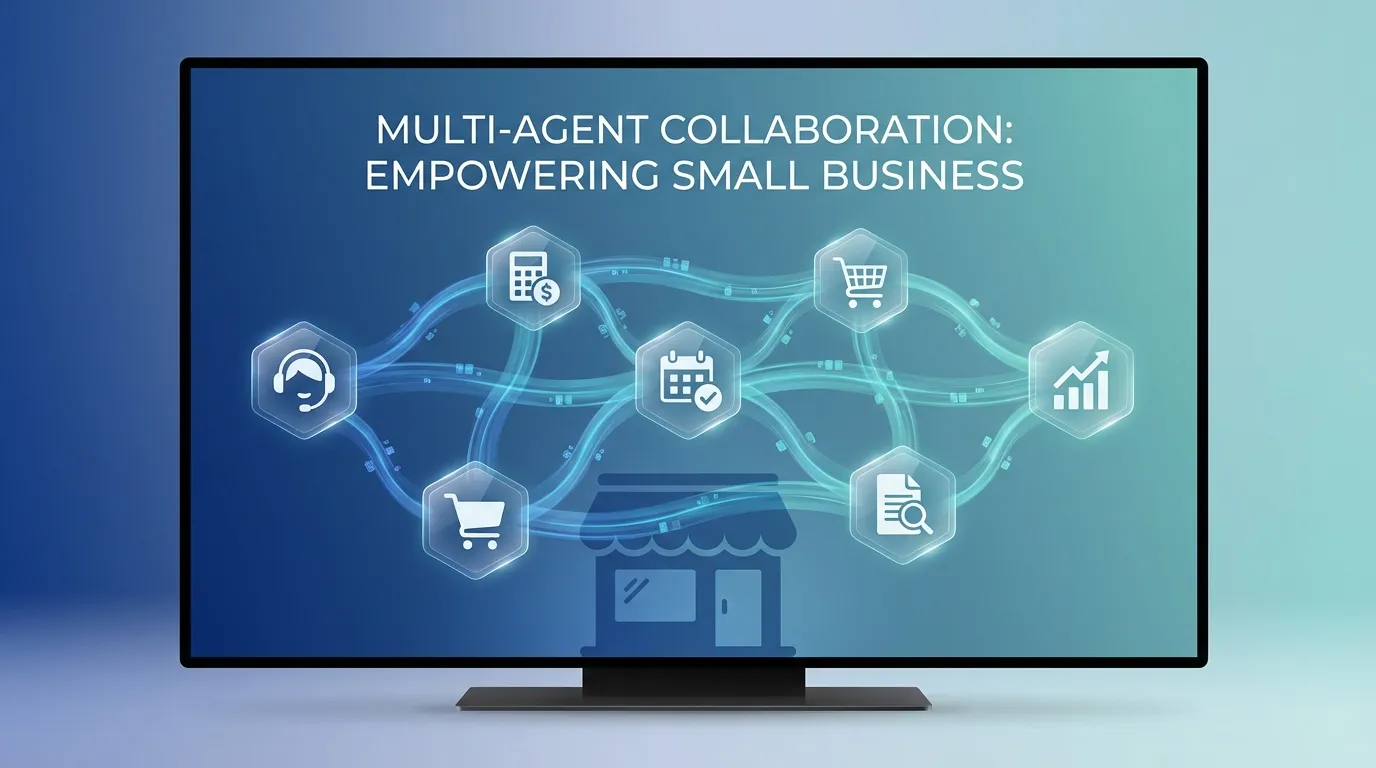
Multi-agent systems. Instead of single agents handling individual tasks, we're seeing networks of specialized agents that collaborate. One agent might handle customer communication, another manages inventory, a third handles scheduling, and they coordinate automatically. IDC forecasts that by 2030, 45% of organizations will orchestrate AI agents at scale across business functions.
Industry-specific agents. Generic AI is giving way to specialized solutions. Expect to see agents designed specifically for dental practices, accounting firms, retail stores, and other verticals. These purpose-built agents understand industry terminology, compliance requirements, and common workflows out of the box.
Better governance tools. As agents become more capable, oversight becomes more important. PwC predicts 2026 will see widespread adoption of AI governance frameworks specifically designed for agentic systems. This includes audit trails, permission controls, and automated compliance checking.
Lower barriers to entry. DIY agentic AI tools are becoming more accessible. No-code platforms now allow business owners to create simple agents without programming knowledge. Costs are dropping too, with many solutions starting under $100 per month.
Getting Started: Practical First Steps
If you're considering AI agents for your business, here's a sensible approach:
1. Inventory your current workflows. Document your most time-consuming repetitive processes. Note where bottlenecks occur, what decisions are required, and how much time each step takes. This gives you a baseline for measuring improvement.
2. Check your existing tools. Many software platforms are adding AI agent capabilities. Before looking elsewhere, explore what's available in tools you already pay for. QuickBooks, Salesforce, HubSpot, Microsoft 365, and Google Workspace all have AI features that may already address your needs.
3. Pick one high-impact, low-risk pilot. Don't try to transform everything at once. Choose a single workflow where an AI agent could save significant time without catastrophic consequences if something goes wrong. After-hours customer inquiry handling is a common first choice.
4. Set clear success metrics before you start. Define what success looks like: hours saved, response time reduced, error rate decreased, customer satisfaction improved. Without metrics, you won't know if the investment is paying off.
5. Build in human oversight. Especially in the early stages, maintain checkpoints where humans review agent actions. This catches errors before they compound and helps you understand where the agent needs adjustment.
The Bottom Line
AI agents represent a genuine shift in what's possible for small businesses. They're not just faster chatbots. They're digital workers that can handle entire workflows, adapt to changing situations, and operate around the clock.
But they're also not magic. They require clean data, clear processes, thoughtful oversight, and realistic expectations. The businesses getting the most value from AI agents aren't the ones chasing every new capability. They're the ones methodically applying proven tools to well-defined problems.
The gap between small businesses and enterprise competitors has always been resources: bigger companies could afford more staff, better systems, and round-the-clock coverage. AI agents are starting to close that gap. A five-person company can now provide 24/7 customer support, automate complex workflows, and free up their team for strategic work.
That's not hype. That's the practical reality of where AI is heading. The question isn't whether to pay attention to AI agents. It's how quickly you can find the right applications for your business.